
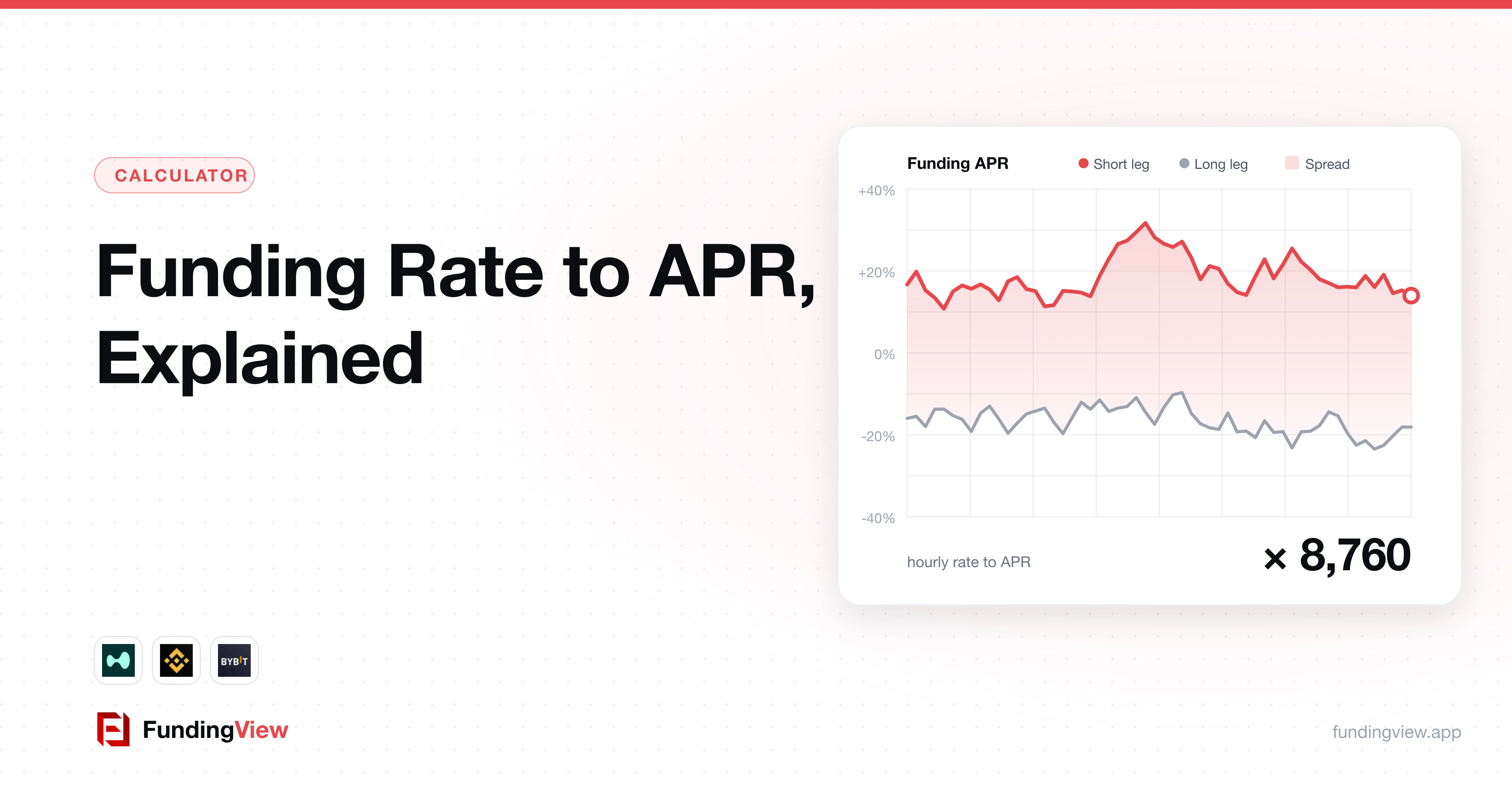
Funding Rate APR Calculator: Convert Any Funding Rate to APR, Daily and Monthly Returns
The formulas to turn a funding rate into hourly, daily, monthly and yearly returns, with worked examples for 1h, 4h and 8h intervals and for a two-leg arbitrage.
Exchanges show funding as a small percentage per interval. To compare venues or judge a trade, you need it per hour, per day, per month and per year. Here are the formulas and worked examples.
The FundingView dashboard does these conversions for every market. Switch the timeframe (1h, 8h, 1d, 1w, 1m, 3m, 1y) to see returns in the unit you want.
The formulas
Start from the displayed rate r and the market's interval h in hours:
- Hourly rate = r ÷ h
- Daily = hourly × 24
- Monthly (30 days) = hourly × 720
- APR = hourly × 8,760
These are simple (non-compounded) returns, which is how funding is actually paid: on the position's notional, not reinvested.
Worked examples
| Displayed | Interval | Hourly | Daily | APR |
|---|---|---|---|---|
| 0.0100% | 8h | 0.00125% | 0.030% | 10.95% |
| 0.0100% | 4h | 0.00250% | 0.060% | 21.90% |
| 0.0100% | 1h | 0.01000% | 0.240% | 87.60% |
| −0.0050% | 1h | −0.00500% | −0.120% | −43.80% |
Turning a rate into dollars
Payment per interval = notional × r
$25,000 at 0.01% per 8h: $2.50 per settlement, $7.50 a day, about $2,738 a year if the rate stays constant.
A two-leg arbitrage
Long on venue A at −10% APR (longs get paid), short on venue B at +20% APR (shorts get paid):
Spread = 20% − (−10%) = 30% APR
With $10,000 per leg, $20,000 total, the spread applies to one leg's notional: 30% × $10,000 = $3,000 a year, before costs.
Now subtract costs: four trades at 5 bps = 0.2% of $10,000 = $20. Held 30 days, net ≈ $3,000 × 30/365 − $20 ≈ $226.
Quick reference
- 1 bp per hour ≈ 87.6% APR
- 1 bp per 8 hours ≈ 10.95% APR
- 10% APR ≈ 0.00114% per hour
FAQ
Why not compound? Funding is paid on notional. Unless you increase position size, payments do not compound.
Why do backtests differ from APR × time? Rates change every hour. Backtests use the real history.
Related: Funding intervals explained · How to backtest