
What Are Funding Rates? How Perpetual Funding Works in 2026
Funding rates keep perpetual futures tied to spot. Learn who pays whom, how often, how to read hourly vs 8-hour rates, and how traders turn funding into yield.
A funding rate is a periodic payment between the longs and the shorts of a perpetual futures contract. It is the mechanism that keeps a contract with no expiry date trading close to the spot price of its asset.
If you hold a perp position, you pay or receive funding every interval, whether your trade is winning or losing. Over weeks, funding can be worth more than the price move you were trading. That is why it is worth understanding properly.
See live funding on 18 perp DEXs →
Why perpetual futures need funding
A classic future expires. On expiry day it settles at the spot price, so its price converges to spot on its own.
A perpetual never expires. Without a mechanism, its price could drift away from spot forever. Funding is that mechanism:
- When the perp trades above spot (too many longs), the funding rate is positive: longs pay shorts. Holding a long gets expensive, some longs close, and the price comes back down.
- When the perp trades below spot (too many shorts), the funding rate is negative: shorts pay longs.
The rate is usually computed from the premium between the perp price and the index price, plus a small interest component, and capped by each exchange.
How much do you actually pay?
Funding is paid on your position size, not your margin:
Payment = position notional × funding rate for the interval
A $10,000 long with a funding rate of +0.01% per 8 hours pays $1 every 8 hours, or about $3 a day. With 5x leverage your margin is only $2,000, but you still pay on the full $10,000.
Funding is only paid if you hold the position at the settlement time. Opening right after a settlement and closing right before the next one means you pay nothing for that interval.
Hourly, 4-hour and 8-hour funding
This is where most comparisons go wrong. Exchanges do not all settle on the same schedule:
| Venue type | Typical interval | Examples |
|---|---|---|
| Most perp DEXs | 1 hour | Hyperliquid, Lighter, Paradex, Extended |
| Most CEXs | 8 hours, 4 hours on volatile pairs | Binance, Bybit, OKX, Bitget |
| Some venues | 1 hour on every market | Kraken Futures |
| Continuous | accrues every block | gTrade |
On Bybit, MEXC and Bitget, close to half of the USDT perps settle every 4 hours instead of 8. A raw "0.01%" on an 8-hour market and "0.01%" on a 4-hour market are not the same rate.
FundingView converts every market to the same unit, the hourly rate, using the native interval of each market, then shows it as an APR:
APR = hourly rate × 24 × 365
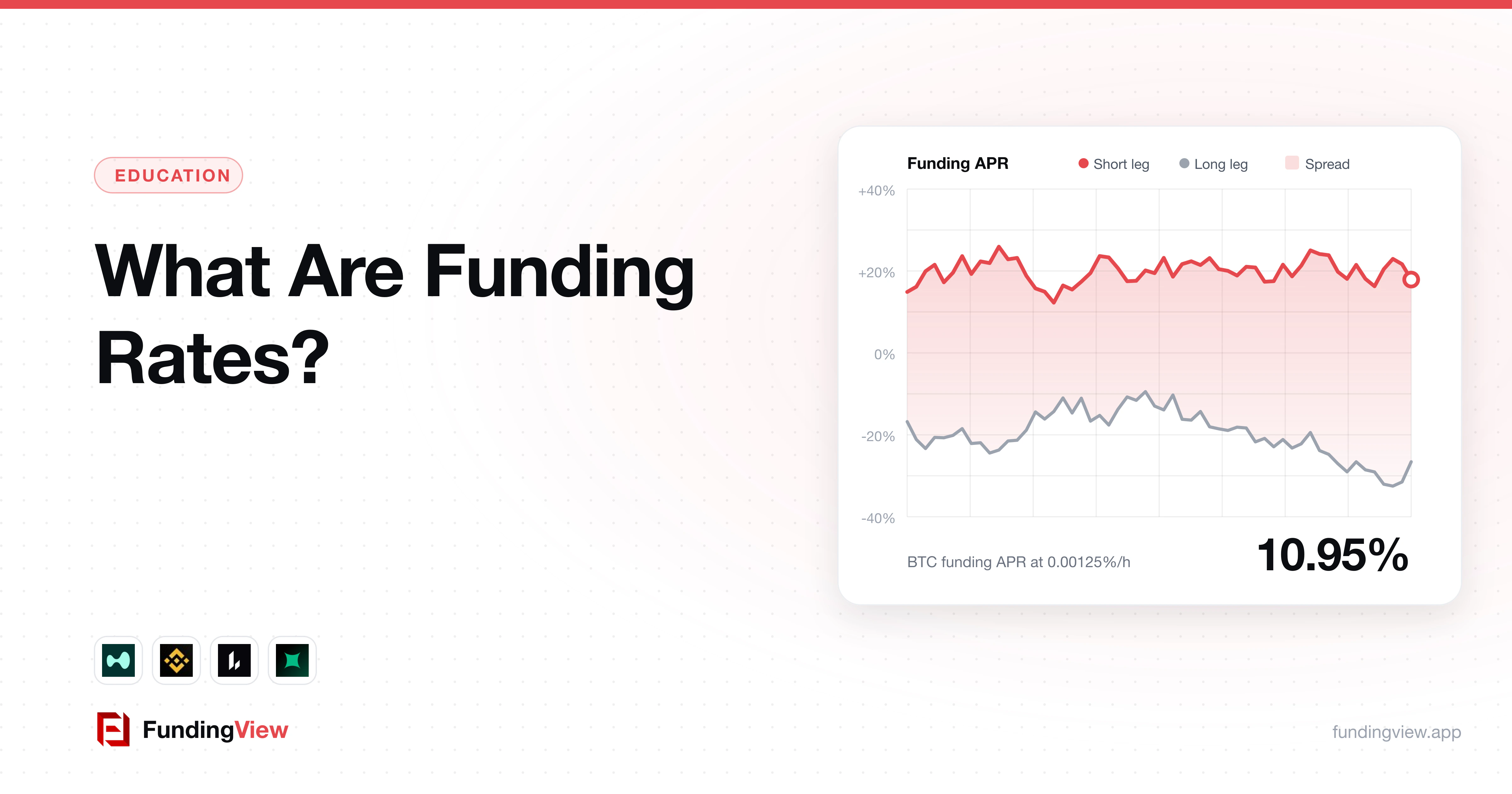
A BTC funding rate of 0.00125% per hour is about 10.95% APR. You can switch the timeframe (1h, 8h, 1d, 1y) on the dashboard to see the same number in the unit you prefer.
What drives the funding rate
- Positioning. When the market is euphoric and leveraged longs pile in, funding goes up. In sell-offs it often turns negative.
- Venue audience. Each exchange has its own traders. A memecoin can pay +80% APR on one venue and −20% on another at the same time.
- Caps and formulas. Each venue clamps funding differently. Hyperliquid caps hourly funding, while gTrade and Carbon use separate long and short rates.
- Asset type. Stock and commodity perps (RWAs) follow their own patterns, especially around market hours and weekends.
How traders use funding
Funding is a cost if you are on the paying side, and a source of yield if you are on the receiving side. The classic strategies:
- Funding arbitrage (perp vs perp). Long the asset where funding is lowest, short it where funding is highest. Your price exposure cancels out and you collect the difference. See our guide to funding rate arbitrage across DEXs and CEXs.
- Cash and carry (spot vs perp). Buy spot and short the perp when funding is positive. See spot-perp funding arbitrage.
- Timing entries. If you are going to hold a directional long anyway, choosing the venue with the lowest funding saves real money over time.
Reading funding on FundingView
FundingView tracks live funding on 18 perp DEXs, with 11 CEXs for Premium members, in one table:
- the dashboard ranks every long/short combination by net APR, with each leg's native interval;
- the live funding heatmap shows the most listed pairs across every venue;
- the backtester replays a strategy on months of history;
- Execution Cost tells you how much slippage a given size costs on each venue.
FAQ
Is a positive funding rate good or bad? It depends on your side. Positive funding costs longs and pays shorts.
Why is the funding on my exchange different from another one? Each venue computes funding from its own order book and its own traders. These gaps are exactly what funding arbitrage collects.
Do I pay funding if I close before the settlement? No. Funding is paid only on positions open at the settlement time.
Why does FundingView show APR instead of the raw rate? Because intervals differ (1h, 4h, 8h). An annualised number is the only way to compare venues fairly.
Want the vocabulary in one place? Read the funding rate glossary.