
Is Funding Arbitrage Safe? The Real Risks of Delta-Neutral Strategies
Funding arbitrage removes price risk, not every risk. An honest look at liquidation, venue, execution, funding-flip and basis risks, and how to size positions so none of them hurts too much.
Funding arbitrage is often sold as "risk-free yield". It is not. It removes price risk, which is the biggest risk in crypto, but several others remain. Here is each one and how to manage it.
1. Liquidation risk
Each leg sits on its own venue with its own margin. A sharp move can liquidate one leg while the other is in profit on a different venue.
Manage it: 2x to 3x leverage, extra margin on both sides, rebalance after big moves, set alerts.
2. Funding-flip risk
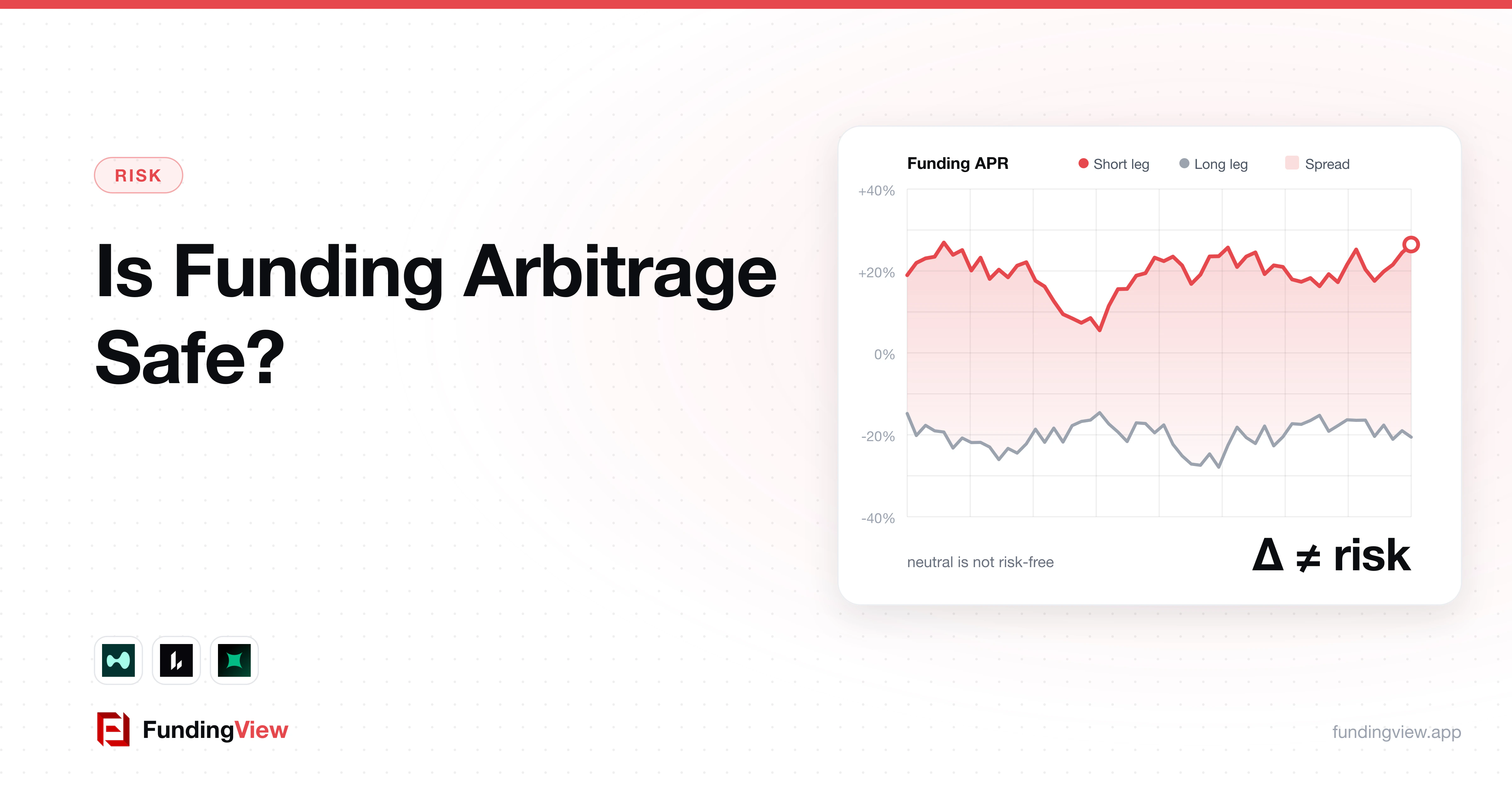
Spreads change. Yesterday's +30% APR can be −10% today.
Manage it: favour spreads with a long stable history (check the strategy score), and exit when the spread stays negative.
3. Execution risk
Fees and slippage on four trades can exceed the funding earned on short holds.
Manage it: check execution cost, use limit orders, hold longer. See the slippage guide.
4. Venue risk
Smart contract bugs, oracle failures, paused withdrawals, insolvent exchanges, collateral depegs.
Manage it: spread capital across venues, keep less on smaller ones, follow venue announcements.
5. Asset-mismatch risk
The same ticker can be two assets. A long on CAT the stock and a short on CAT the memecoin is two directional bets.
Manage it: check prices on both legs. FundingView splits mismatched tickers by price.
6. Basis and gap risk on RWAs
Stocks and commodities stop trading on weekends while perps keep going. Prices can gap when markets reopen, and the two venues may reprice differently.
Manage it: lower leverage on RWAs, avoid entering just before weekends, read RWA funding arbitrage.
7. Operational risk
Wrong size on one leg, an order that did not fill, a forgotten position.
Manage it: double-check notional on both legs right after opening, and keep a simple log.
So, is it safe?
Done carefully, funding arbitrage is one of the lower-risk strategies in crypto: no bet on direction, returns from a structural source. Done carelessly, especially with high leverage, it can lose money fast.
FAQ
What is a sensible leverage? 2x to 3x per leg for majors, lower for volatile assets and RWAs.
Can I lose more than my margin? On most venues, losses stop at your margin through liquidation, but you can still lose all of it on one leg.
Related: 10 funding arbitrage mistakes · Delta-neutral crypto yield